What UK & European FEC Operators Should Look for at IAAPA Expo Europe 2026
A working framework for evaluating indoor entertainment solutions in London this September — beyond the show floor’s individual attractions.
Every September, the leisure industry’s largest European gathering pulls procurement teams, mall developers, and independent operators into one hall to compare what several hundred suppliers are building next. For anyone planning or expanding a family entertainment center (FEC) in the UK or on the continent, that concentration of options is useful — and also easy to misuse. Walking a show floor attraction by attraction, collecting brochures, tends to produce a wish list rather than a workable project.
This article is written for the operator’s side of that conversation: what to actually evaluate when comparing indoor entertainment solutions at IAAPA Expo Europe 2026, regardless of which manufacturer you end up choosing.
IAAPA Expo Europe 2026: What Operators Should Know
IAAPA Expo Europe 2026 returns to London, running at ExCeL London (Royal Victoria Dock) from 21–25 September 2026, with the show floor itself open 22–24 September.[1][2] The event carries IAAPA’s official description as the leisure industry’s premier event in Europe, and for 2026 organizers describe it as a record-breaking edition: more than 870 exhibitors are listed, alongside 60-plus education sessions.[1] A new Food & Beverage zone has also been added to the show floor for this edition.[1]
The education program runs across the full 21–25 September window, ahead of and alongside the exhibition days, and includes a dedicated Sustainability Day on 21 September featuring speakers from operators and manufacturers including Disney, Vekoma, Efteling, Looping Group, and PortAventura World.[1] Separately, the IAAPA Institute for Attractions Professionals runs as a two-day in-person program on 19–20 September for industry professionals earlier in their careers.[1] IAAPA Expo Europe 2026 has also been certified as a sustainable event by Greentime, an independent certification covering areas from transport and waste management to working conditions and financial sustainability.[3]
For an FEC operator, the practical takeaway is less about the headline numbers and more about scale: with several hundred exhibitors on one floor, a structured evaluation approach matters more than enthusiasm for any single booth.

1. Look Beyond Individual Attractions
It’s tempting to walk a show floor the way a shopper walks a market — stopping at whatever looks most striking. But a family entertainment center isn’t a collection of attractions; it’s a single guest journey with a beginning, middle, and end. An attraction that photographs brilliantly on its own can still be the wrong choice if it creates a bottleneck in circulation, sits awkwardly against your age segmentation, or breaks the sightlines your supervision plan depends on.
Before evaluating any specific piece of equipment, it’s worth asking how it behaves inside a full venue:
- Circulation: Does this attraction create a natural flow toward and away from it, or does it concentrate guests at a single pinch point during busy periods?
- Age segmentation: Does it belong in a zone with a coherent age band, or does it invite mixed-age use that complicates supervision?
- Dwell time: Is the expected time-on-attraction compatible with your throughput model, or will it either empty too fast or hold guests too long relative to your capacity plan?
- Supervision: Can staff maintain clear sightlines to this attraction from a fixed post, or does it require dedicated, continuous monitoring?
- Visual identity: Does the attraction reinforce your venue’s theme and color story, or will it need to be re-skinned to avoid looking bolted-on?
- Interaction with neighboring attractions: Does exit traffic from this feature collide with entry queues for another?
None of this is visible from a spec sheet. It only becomes clear when you ask the exhibitor to walk you through how the attraction sits inside a floor plan — ideally one similar in shape and size to your own site.
2. Evaluate Attractions by the Experience They Create
Equipment specifications — climb height, slide length, load capacity, materials — matter, but they answer a different question than the one that actually determines commercial performance: what experience does a guest walk away with? Two attractions can carry near-identical technical specs and produce completely different guest behavior, because one is designed around a single physical skill and the other is designed around a social or narrative arc.
It’s worth deliberately separating the categories operators tend to blend together when comparing options:
- Physical play — climbing structures, ball pits, trampolines, and soft-contained play systems built primarily around gross motor activity.
- Climbing and sliding — the structural core of most indoor playgrounds, where geometry and material choice determine both safety margins and repeat-play appeal.
- Interactive and sensor-based elements — features that respond to guest input, which tend to extend dwell time but also introduce maintenance and software dependencies worth understanding up front.
- Sports and skill-based attractions — bowling, trampoline parks, competitive games — which appeal to older children, tweens, and adults, and typically carry a different revenue model (session-based rather than open play).
- Social play — attractions designed for group or parallel use, which tend to outperform solo-use equipment on repeat visits because they support the social occasion, not just the physical activity.
- Immersive theming — the narrative and environmental layer wrapped around any of the above, which shapes perceived value and photo-sharing behavior more than the underlying equipment does.
No category is inherently superior — a venue built around families with toddlers has a different mix than a venue targeting tweens and teens. What matters is asking a supplier to explain the experience an attraction is designed to create, not just its physical dimensions.
3. Consider Multi-Age Entertainment
Most FECs don’t serve a single age group; they serve a family unit that includes several at once — a toddler, an older sibling, and at least one accompanying adult. An attraction lineup that ignores this reality tends to underperform even when each individual piece is well built, because it forces one age group to wait while another plays, or puts incompatible age groups in the same physical space.
Operators evaluating suppliers at IAAPA Expo Europe should ask specifically how a proposed layout handles:
- Toddlers, who need low-risk, softly bounded play zones separated from faster-moving older children.
- Young children, who are typically the core demographic for structured indoor playgrounds.
- Older children and tweens, who increasingly expect skill-based or competitive elements rather than open-play structures alone.
- Parents and accompanying adults, whose comfort — seating, sightlines, food and beverage access — directly affects how long a family stays and how likely they are to return.
Age zoning is a design discipline, not an afterthought applied after the attractions are chosen. Ask suppliers to show how their proposed layout physically separates age bands while keeping the whole space feeling like one coherent venue rather than several disconnected rooms.
4. Think About the Existing Building, Not Just the Equipment
Most European and UK FEC projects are fit-outs, not new-build construction — a former retail unit, warehouse, or leisure box that has to be adapted rather than designed from a blank slate. That reality changes what “the right attraction” even means. A signature slide tower that works beautifully in a rendering may be structurally impossible in a building with 4.2-meter ceiling clearance and a mid-floor support column exactly where the tower’s footprint needs to go.
Before committing to any attraction concept, operators should be prepared to share — and suppliers should be asking for — details on:
- Ceiling height, including any variation across the floor plate and the location of ductwork, sprinklers, or beams that limit vertical structures.
- Columns and other fixed structural elements that constrain layout.
- Circulation routes, entrances, and how guest flow needs to interact with existing retail or leisure-center traffic.
- Sightlines from reception, café, and staff posts.
- Floor conditions and load-bearing capacity, particularly for multi-level structures.
- Fire exits and evacuation routes, which UK and EU fire safety requirements will constrain regardless of attraction design.
- Available back-of-house space for storage, maintenance access, and staff facilities.
This is where the case for custom design becomes practical rather than promotional: a building with irregular columns or a low mezzanine genuinely performs better with a layout engineered around its constraints than with a standard catalog configuration forced to fit. Suppliers who ask detailed building questions before proposing a concept are generally further along in project-delivery maturity than those who lead with a fixed product list.
5. Ask About Safety and Compliance
What should be checked before installing an indoor playground? Before any equipment moves forward from concept to contract, operators should confirm which standards a supplier’s equipment is designed and tested against, request the supporting documentation, and understand who is responsible for post-installation inspection and maintenance.
European indoor playground equipment is generally expected to align with the EN 1176 series (covering playground equipment design and general safety requirements) and EN 1177 (covering surfacing and impact attenuation), which are the principal European playground safety standards administered through CEN, the European Committee for Standardization.[4][5] Soft-contained play structures — the ball pits, climbing nets, and tube systems common in indoor FECs — are also frequently referenced against ASTM F1918, the safety performance specification for soft contained play equipment, and ASTM F1487, the consumer safety performance specification for public-use playground equipment, both maintained by ASTM International.[6]
It’s worth being precise here rather than treating compliance as a single checkbox: European regulatory requirements vary by equipment type, by whether a structure is classified as playground equipment or as an amusement device, and in some cases by local UK or national implementation of EU-derived standards. A credible supplier should be able to name which specific standards apply to each piece of equipment they’re proposing, rather than offering a single blanket certification claim for an entire attraction package. Operators should also ask about test documentation, materials certification, manufacturer quality system credentials such as ISO 9001, and independent testing bodies such as SGS or ISO/IEC 17025-accredited labs — and should expect to receive, not just be told about, the relevant paperwork.

6. Evaluate the Manufacturer’s Ability to Deliver the Whole Project
What should I ask an indoor playground manufacturer? Beyond the attraction itself, ask how the manufacturer handles every stage between concept and opening day — because the gap between those stages is where most FEC project delays and budget overruns actually happen.
A full-service capability typically spans:
- Concept development — translating a business plan and site into an initial spatial and thematic concept.
- Planning and layout — working through circulation, age zoning, and capacity against the actual building.
- 3D design — detailed visualization that lets an operator sign off on a layout before fabrication begins.
- Engineering — structural calculations, load analysis, and compliance review specific to the site and local code.
- Manufacturing — in-house production versus subcontracted fabrication, which affects both quality control and lead time.
- Quality control — inspection protocols before equipment ships, not only after it’s installed.
- Logistics — freight, customs handling for equipment manufactured outside the UK or EU, and delivery scheduling against a fit-out timeline.
- Installation — whether the manufacturer’s own crews install, or whether it’s handed to a third-party contractor with variable familiarity with the equipment.
- After-sales support — spare parts availability, response time for service requests, and whether support is local or requires shipping components internationally.
Suppliers who can speak fluently to all nine stages — with named points of contact and realistic timelines for each — are generally lower-risk partners than those who are strongest on design and vaguer on logistics, installation, and after-sales.
7. Look for Attractions That Can Give a Venue Its Own Identity
What makes an indoor playground commercially useful? Beyond safe, well-built equipment, a commercially useful indoor playground gives a venue something guests can’t get at the competing FEC down the road — a signature element that becomes the reason for a return visit, not just a reason for the first one.
A signature attraction doesn’t need to be the largest or most technically complex piece in a venue. It needs to fit the audience the venue actually serves, the space it has to work with, the theme it’s built around, and the operating model — open play versus timed sessions, for example — that the business runs on. A dramatic multi-story slide tower is a strong signature piece for a large-format destination venue with high ceilings and a family day-trip audience; it’s the wrong signature piece for a compact neighborhood FEC where the real differentiator might instead be a themed social-play zone or a competitive game area suited to a shorter, more frequent visit pattern.
Luckyplay’s Matrix Slide 5.0 is one example of this principle in practice: a custom-engineered slide concept designed to be adapted to a specific building envelope and audience rather than installed as a fixed catalog product. The broader point holds regardless of which manufacturer an operator works with — a signature attraction earns its place by fitting the venue, not by being the most visually dramatic option on a show floor.
8. Don’t Ignore Operations
Attractions that look identical on a show floor can have very different total costs of ownership once they’re running eight, ten, or twelve hours a day, seven days a week. Operational questions are easy to skip during the excitement of a trade show, but they determine day-to-day profitability far more than the initial purchase price does.
Before finalizing a decision, operators should understand:
- Cleaning requirements — how often, with what products, and whether cleaning requires the attraction to close.
- Inspection routines — what a daily, weekly, and annual inspection schedule looks like, and who is qualified to perform it.
- Maintenance demands — which components wear fastest, and what routine maintenance actually costs in staff time and parts.
- Staff visibility requirements — how many supervision points the attraction needs, and whether that matches your staffing model.
- Replacement parts — lead time and cost for common wear items, and whether parts are stocked in the UK/EU or shipped from further afield.
- Operational flexibility — whether the attraction can be reconfigured or partially closed during quieter periods without disrupting the whole venue.
- Downtime impact — what happens to guest flow and revenue if this specific attraction is out of service for a day, a week, or longer.
A supplier who can answer these questions in specific, concrete terms — rather than general reassurance — is signaling that they’ve supported venues through years of actual operation, not just installation day.
How should operators compare playground suppliers?
Compare suppliers against the same framework used to evaluate every attraction: guest experience fit, building compatibility, documented safety compliance, full-project delivery capability, and operational cost of ownership — not against a single headline attraction or a lowest quoted price. A structured comparison across these five dimensions surfaces differences that a brochure or a booth conversation alone won’t.
9. Ten Questions to Ask Exhibitors at IAAPA Expo Europe
A short, consistent question set makes it possible to compare exhibitors fairly, even after a long day walking the show floor. These ten cover the ground this article has worked through, condensed into a checklist that can be used booth to booth.
- How does this attraction’s design account for circulation, age segmentation, and supervision within a full venue layout — not just in isolation?
- Which specific safety standards (EN 1176/1177, ASTM F1918/F1487, or others) apply to each piece of equipment you’re proposing, and can I see the test documentation?
- Is the equipment manufactured in-house, and what quality control steps happen before it ships?
- Who installs the equipment — your own crews or a third-party contractor — and what’s a realistic installation timeline for a site like mine?
- Can you design around an existing building’s ceiling height, columns, and floor plan, or does your process start from a fixed product catalog?
- What does a routine maintenance schedule look like for this attraction, and what does it typically cost in staff time per month?
- How quickly can replacement parts reach a UK or European site, and are common wear parts stocked locally?
- What documentation will I receive — CE marking, test certificates, installation manuals — before and after installation?
- Can you provide references from operators running similar attractions for at least two years, not just recent installs?
- What does after-sales support actually look like in year two and year three, after the initial installation relationship ends?
What IAAPA Expo Europe Can Tell You About the Direction of Indoor Entertainment
It’s worth separating three different kinds of signal an event like this produces, because they carry different weight.
First, what IAAPA officially highlights: for 2026, that includes an expanded education program with more than 60 sessions, a dedicated Sustainability Day, and continued attention to intellectual-property partnerships in attractions — IAAPA’s own coverage of the 2025 edition, for instance, detailed a Lego and Merlin Entertainments partnership discussed during an education session on integrating IP into attractions.[7] The organization has also built out its EDUTours program, including a 2026 session offering a behind-the-scenes look at Merlin Entertainments’ Halloween attraction development, hosted at Thorpe Park.[1]
Second, broader industry observations that show up across multiple exhibitors and sessions without being an official IAAPA theme — things like the growing presence of skill-based and competitive social games alongside traditional soft play, or the increasing frequency with which suppliers pitch full-service, design-through-installation capability rather than equipment alone. These patterns are worth watching, but they’re observations from the show floor, not IAAPA-published trend data.
Third, professional interpretation — the kind of judgment an experienced operator or designer brings to what they’re seeing, informed by pattern but not itself a fact from the show. This article’s evaluation framework falls into that third category: it’s a lens for interpreting what’s on the floor, not a summary of IAAPA’s own trend forecasts. Readers should treat unattributed observations accordingly, and weigh them against their own site visits and conversations with exhibitors.
How to Turn an IAAPA Visit Into a Better FEC Project Decision
The value of a show like this isn’t the day itself — it’s what an operator does with the three or four days of notes, business cards, and half-finished conversations afterward. A simple structure helps turn that raw material into an actual decision:
- Score, don’t just remember. Use the same short set of criteria — guest experience fit, building compatibility, safety documentation, full-project capability, operational cost — for every exhibitor you spoke with, while the details are still fresh.
- Request documentation before you request a quote. Ask shortlisted suppliers to send test certificates, reference project details, and a sample project timeline before pricing conversations begin. Suppliers who respond quickly and specifically tend to behave the same way during the project itself.
- Site-check before you sign. Share your actual building drawings — ceiling heights, column positions, fire exits — with your top two or three suppliers, and compare how each one’s proposed layout changes once it meets your real constraints.
- Talk to existing operators, not just references chosen by the supplier. Ask suppliers for operators running comparable venues for at least two years, and ask those operators specifically about maintenance costs and after-sales response time.
- Decide on total cost of ownership, not headline price. Factor in installation, expected maintenance, part replacement, and realistic downtime before comparing final numbers across suppliers.
An exhibition floor is designed to be persuasive in the moment. A decision made three weeks later, against documented criteria and a real building plan, tends to hold up better than one made on the show floor itself.
FAQ
What should FEC operators look for at IAAPA?
Operators should evaluate attractions as part of a complete guest journey — circulation, age segmentation, supervision, and building fit — rather than judging equipment in isolation. Safety documentation, full-project delivery capability, and operational cost of ownership matter as much as an attraction’s visual appeal.
What should I ask an indoor playground manufacturer?
Ask which safety standards apply to each specific piece of equipment, whether manufacturing and installation are handled in-house, what documentation you’ll receive, and what after-sales support looks like in year two and beyond — not just at handover.
What makes an indoor playground commercially useful?
A commercially useful playground fits its audience, space, and operating model closely enough to become a reason guests return — typically through a signature attraction or zone that differentiates the venue, supported by safe, well-documented, well-maintained equipment.
How should operators compare playground suppliers?
Compare suppliers against the same criteria for every conversation — guest experience fit, building compatibility, documented safety compliance, full-project delivery capability, and operational cost — rather than comparing single attractions or headline prices in isolation.
What should be checked before installing an indoor playground?
Confirm which European or international standards (such as EN 1176/1177 or ASTM F1918/F1487) apply to the specific equipment, request test and materials documentation, and clarify inspection and maintenance responsibilities before installation begins.
When and where does IAAPA Expo Europe 2026 take place?
Education programming runs 21–25 September 2026, with the show floor open 22–24 September, at ExCeL London, Royal Victoria Dock.[1][2]
Is IAAPA Expo Europe only relevant if I’m buying equipment immediately?
No. The education program, supplier conversations, and site-comparison research are useful even for operators still in the planning or feasibility stage of a project, well before any purchasing decision is made.
Do European FEC equipment standards differ from those in North America?
Yes. European equipment is generally evaluated against the EN 1176/1177 series administered through CEN, while North American equipment commonly references ASTM standards such as F1918 and F1487. Operators sourcing internationally should confirm which standards a given piece of equipment was designed and tested against, rather than assuming equivalence.
Meet Us at IAAPA Expo Europe 2026
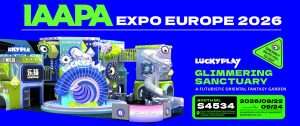
Luckyplay will be attending IAAPA Expo Europe 2026 in London. For operators working through a new build, an existing venue renovation, or a custom attraction concept, it’s a chance to talk through a specific building and site — not a general sales conversation. If you’re attending and want to discuss a project, turnkey delivery, or a renovation concept while you’re there, you can get in touch ahead of the show to arrange a time.
Founded in 2008, Luckyplay operates a 15,000 sqm self-owned factory and a 2,000+ sqm showroom, and has delivered more than 3,000 projects across 50-plus countries, covering in-house design, project management, manufacturing, installation, and after-sales support. You can review examples in Luckyplay’s project case studies, including completed European installations, browse the broader turnkey indoor playground solutions and design approach, or see the full product range. More background is available on the About Luckyplay page.